When Constraints Become the Creative Brief: How Levi's and Gillette Turned Censorship Into 2026's Most Memorable Marketing Moment





Many of the best marketing campaigns begin with a seemingly unsolvable problem instead of a brilliant idea.
The World Cup (heard of it?) gave us one of my favorite recent examples.
When FIFA took control of stadiums across the United States, Canada, and Mexico, one of its requirements was that existing sponsors couldn't receive free advertising during the tournament.
Stadiums were required to sanitize themselves. All branding had to be covered or removed.
That included Levi's Stadium in San Francisco, officially renamed San Francisco Bay Area Stadium for the tournament, and Gillette Stadium in Foxborough, which became "Boston Stadium.”
The iconic Levi's logo was covered with a white tarp. Over in Foxborough, crews took a more granular approach: roughly 65,000 individual pieces of tape, one for every seat, to conceal the Gillette logo across the entire stadium.
There was just one problem: neither cover-up quite did its job.
The Levi's tarp concealed the color of the logo, but not the silhouette. You could still instantly recognize it. And the sea of tape at Gillette Stadium was so extensive and so visible that it became its own spectacle, drawing exactly the kind of attention FIFA was trying to prevent.
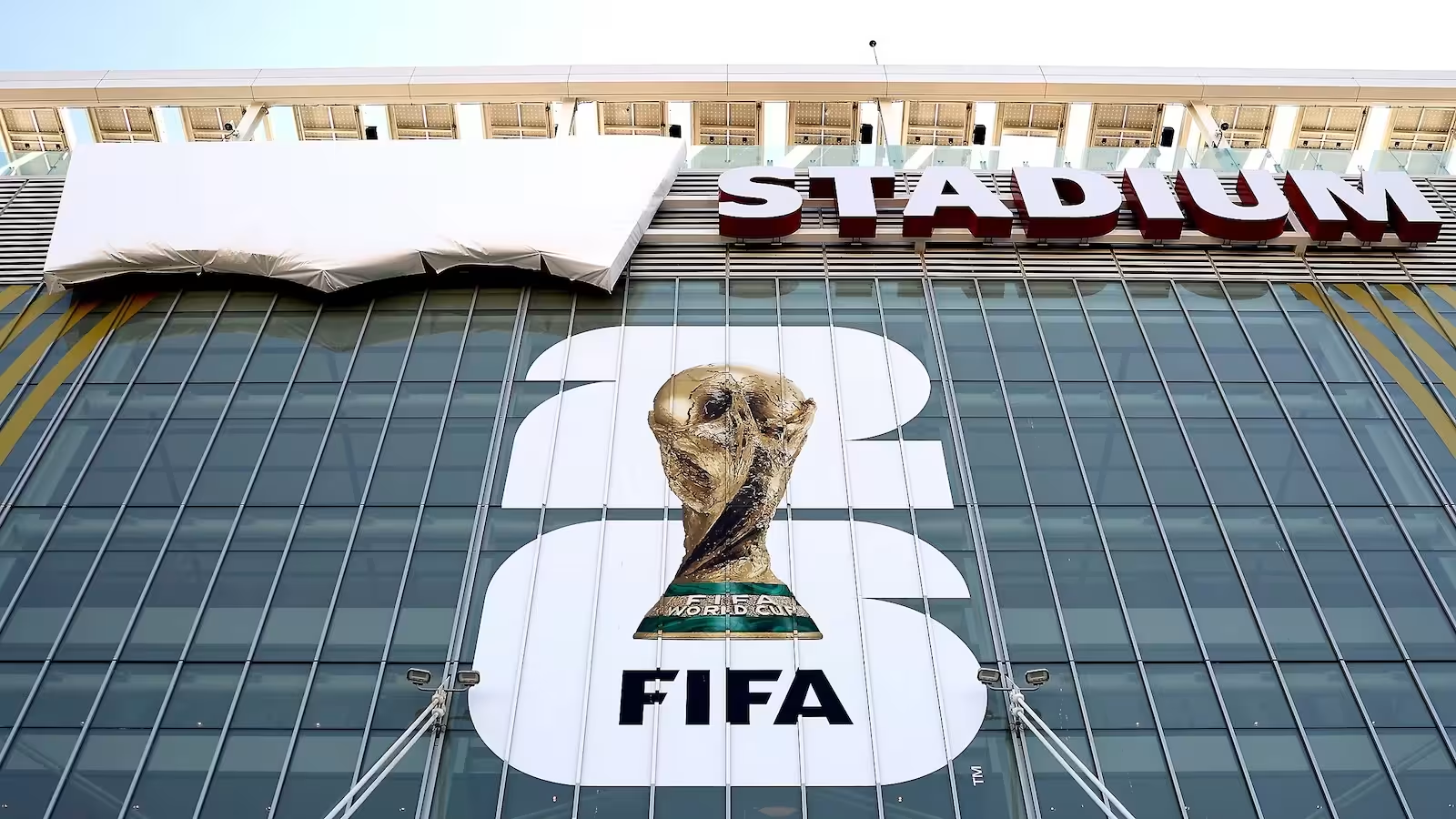
In trying to erase these brands, FIFA had accidentally, and comically, drawn more eyes to them than ever.
Both companies immediately recognized the opportunity.
Levi's changed its social profile pic to the white silhouette, joked about it across social media, released merchandise featuring the "new" logo, and even brought the same white covering into stores in Paris, London, and Hong Kong.
Gillette, meanwhile, leaned all the way into the bit. On social, they posted an image of their Boston Stadium signage “covered” in shaving cream instead of tape—a cheeky, on-brand nod to a razor company literally shaving its own name off the building. They paired it with a caption about the tape job itself: “At least we got to choose how we cover it.”
Even other brands got in on it. Heinz released limited-edition packaging that mimicked the “covered” look. It became a shared bit across the tournament, not just a one-off stunt.
What was supposed to be a branding restriction became one of the most talked-about marketing moments surrounding the tournament.
The Levi's campaign alone generated millions of impressions on social and led to the launch of a new t-shirt line featuring the new logo.
That said, I don't think that was the most interesting part. The real win was that these brands became entertaining.
That's remarkably difficult for an established brand.
When companies reach a certain size, they often become risk-averse. Every campaign is scrutinized. Every joke is workshopped. Every decision moves through layers of approvals. Over time, personality gives way to polish.
Levi's and Gillette both configured this situation to do the opposite.
They took an awkward situation, laughed at themselves, laughed at FIFA, and invited everyone else to laugh with them.
That is self-awareness. And it makes brands feel human.
There's a broader lesson here.
Many marketers think creativity starts with unlimited freedom. In reality, some of the strongest ideas emerge because of constraints.
A limited budget forces sharper messaging.
A short deadline forces faster decisions.
And an unexpected setback often forces you to see and to solve the situation differently.
Bottom line: Constraints don't always limit creativity. Sometimes they become the creative brief.
Neither team spent months planning these campaigns.
They simply recognized that a problem had already captured people's attention and asked a better question.
Not, “How do we fix this?”
But, “How do we make this fun?”
A proposition both marketing teams answered phenomenally during the largest, most-viewed sporting event on the planet.
Bravo, bravo.

The Future of Brand Voice: How to Train AI to Sound Like You (and Not Your Competitors)



You're in good hands.